
Stop Impunity: Independent Medico-Legal Unit (IMLU) Pushes for Operational Coroner Service Act Amid Rising Deaths in Custody
NAIROBI, Kenya, Nov 6 – Kenya is currently grappling with a deeply troubling rise in deaths occurring in police custody, a stark reflection of systemic failings in the country’s justice and accountability mechanisms.
The scale of this crisis is laid bare by recent statistics: between 2024 and 2025 alone, the Independent Medico-Legal Unit (IMLU) documented 17 cases of deaths in custody.
These tragic incidents were not isolated, being reported across a wide geographical of the country spanning police stations, remand facilities and prisons in at least 10 counties, including key regions such as Nairobi, Nakuru, Murang’a, Siaya, Mombasa, Kakamega and Busia
IMLU in regard to the protests have facilitated at least 80 autopsies and in 2025 they have documented 59 deaths through forensics documentation and 17 custodial deaths.
Postmortem examinations conducted by IMLU’s network of forensic pathologists revealed harrowing patterns of injury and neglect.
Additionally, Causes of death ranged from cardiorespiratory failure and cardiogenic shock due to multiple injuries, suggesting physical assault, to asphyxiation and hanging in some cases pointing to possible staging of suicide.
Further, others such as severe head injuries with brain contusions and subdural hematomas, indicate repeated blunt-force trauma and lack of timely medical care.
IMLU noted that each of the deaths represents not only a personal tragedy but also a failure of the state to uphold its duty under Article 26 of the Constitution, the right to life, and Article 29, which protects every person from torture and cruel inhuman, or degrading treatment.
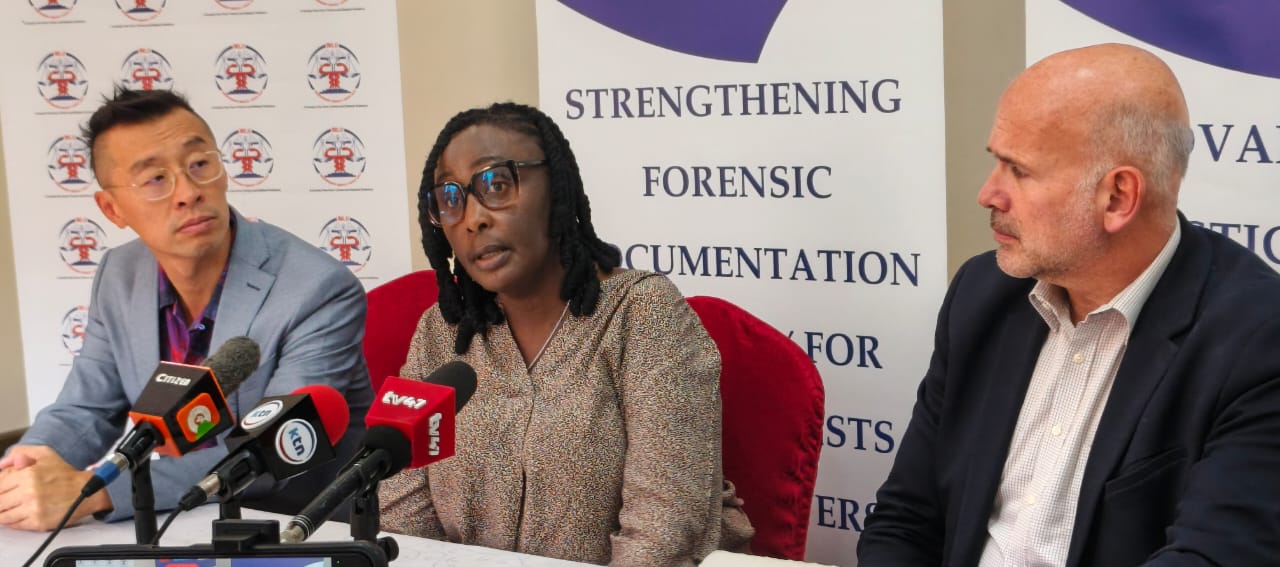
Families year after year are left without answers, investigations stall and justice remains elusive It is within this context that IMLU, with support from the International Rehabilitation Council for Torture Victims (IRCT) has convened a three-day forensic training for pathologists and lawyers drawn from its national network.
The workshop, facilitated by Prof. Dr. Djordje Alempijevic, former head of the Forensic Department at Belgrade University and member of the UN Subcommittee on Prevention of Torture, and Prof. James Lin, Istanbul Protocol ProgrammebCoordinator at IRCT seeks to strengthen the capacity of Kenyan experts in forensic documentation, investigation and reporting of torture and deaths in custody.
“Forensic documentation is the cornerstone of accountability; it transforms pain into proof and evidence into justice, It ensures that deaths in custody are not dismissed as “natural” or “unexplained,” but are investigated using internationally recognized standards such as the Istanbul Protocol, for investigating and documenting torture, and the Minnesota Protocol for investigating unlawful deaths”, they said.
Despite the existence of the National Coroner Services Act (2017), which mandates the establishment of an independent agency to investigate unclear or reportable deaths, its operationalization has been delayed due to administrative gaps, notably the absence of a Cabinet Secretary for Justice as stipulated in the law.
This has left investigations under the jurisdiction of police and state pathologists, undermining impartiality and perpetuating impunity.
IMLU, together with the Police Reforms Working Group–Kenya (PRWG-K) and the Department of Justice continues to advocate for the urgent amendment and operationalization of this Act.
A functioning coroner system would ensure that every death in custody is independently investigated, that families receive timely information and that perpetrators are held accountable.
IMLU added that it remains steadfast in its mission to prevent and respond to torture and related violations.
“By strengthening the capacity of pathologists, lawyers and justice actors in forensic documentation, Kenya moves closer to a future where accountability is not an afterthought, but a standard, where every life lost in state custody is treated not as a statistic, but as a call to action for justice and reform”.