
Okoa Uchumi warns Ksh 4.82tn budget could worsen cost of living, demands Finance Bill Amendments
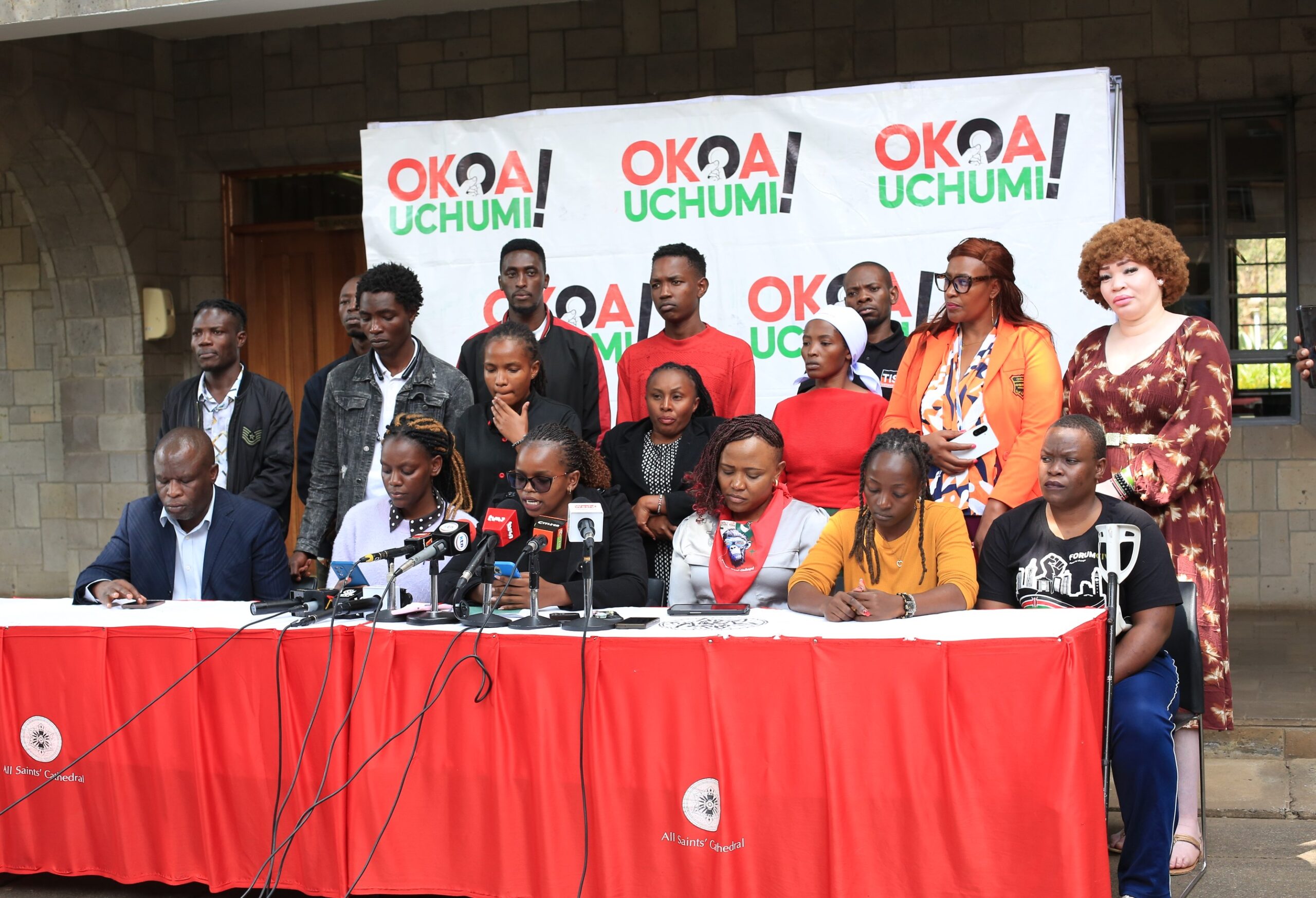
NAIROBI, Kenya, May 22 – The Okoa Uchumi Campaign Coalition has accused the government of driving Kenyans into deeper “socio-economic strangulation” after the National Treasury unveiled a record-shattering Ksh 4.82 trillion budget proposal for the Financial Year 2026/27.
The civil society alliance sounded the alarm over a stark contradiction in state spending, pointing out that the astronomical budget brazenly breaches the government’s own Budget Policy Statement ceiling by Ksh 69.3 billion at a time when foundational public services like healthcare and education are in rapid, visible collapse.
A total of KSh.4.82 trillion is to be financed through taxation projected to raise KSh. 2.986 trillion, this is a highly optimistic tax revenue forecast given the declining economic growth as seen in the recently published economic survey.
They further raised concerns on the widening budget deficit, which exceeds KSh. 1.1 trillion of this amount; domestic borrowing is projected at KSh. 995.7 billion, which constitutes 89.6% of the total proposed borrowing in FY 2026/27.
“This raises serious concerns about the government’s growing reliance on domestic debt financing, its potential to crowd out the private sector, and the collapse of businesses and job losses”.
According to The National Treasury official figures indicates that Kenya’s total public debt stock has hit a record Ksh 12.84 trillion, with domestic debt reaching an unprecedented Ksh 7.07 trillion mark for the first time in history. Treasury’s newly tabled budget estimates acknowledge that gross public debt stock is accelerating rapidly towards Ksh 14 trillion, driven by a projected deficit to be financedby borrowing.
“We note with concern that the proposed borrowing of KSh. 1.1 trillion is towering over the proposed development spending of KSh. 749 billion, This indicates that part of theborrowing will go towards recurrent spending, which contravenes the Public Financial Management (PFM) fiscal responsibility principle that medium-term borrowing be used only for development expenditure”, they said.
On the fuel sector crisis what civil society has long warned: the sovereign Government-to-Government (G-to-G) petroleum framework has become a playground for cartels and conflicted interests.
“The recent revelations have exposed how state actors and preferred oil marketing companies manipulated supply frameworks to orchestrate artificial pressures, this manufactured crisis was used to justify emergencyprocurements that bypassed standard competitive procurement structures for selfish self-gain”.
“Worse still, the public continues to be fleeced to purchase substandard fuel withbelevated sulphur levels, in absolute violation of Kenyan safety and environmental specifications”.
They note that G-to-G framework has systematically distorted market competition, concentrated dollar allocations to benefit a select few, and fundamentally failed to protect consumers from economic shocks.
E”PRA has also increased electricity costs by Ksh 4.16 per kilowatt to cover fuel, power purchase structure, and forex costs! Who is looking out for households that have been sinking deeper into poverty, even as malnutrition grows to 36% this year, 14% points higher than in 2016″.
Through the proposed measures in the Finance Bill 2026, Instead of curbing corruption and sealing fiscal leaks, the National Treasury is weaponizing the tax regime by expanding its administrative fiat.
Additionally, they note that Draft Finance Bill 2026 contains dangerous amendments to the Tax Procedures Act that seek to grant the Kenya Revenue Authority (KRA) unprecedented, unchecked powers to mine private citizens’ data.
Through automated data-matching algorithms across platforms like Etims, banking records, and third-party withholding tax declarations, the KRA intends to bypass voluntary self-assessment and arbitrarily pre-populate individual tax liabilities.
The same time, the Bill widens tax exemptions for high-net-worth individuals, large asset holders, and sophisticated investors, while narrowing protections for ordinary taxpayers. It creates deliberate loopholes that wealthy tax avoiders can and will exploit.
“The result is a tax regime that promotes inequality, protects elite interests and shifts the burden of taxation onto ordinary Kenyans”.
The combination of an unconstitutional budget deficit, energy cartel manipulation, and punitive tax enforcement means the cost of living for the average Kenyan household is on a catastrophic trajectory.
Pump prices and inflated electricity tariffs are driving up transport, distribution and manufacturing costs, which are cascading directly into a massive spike in shelf prices for basic food commodities.
Kenya Revenue Authority (KRA) automatically disallowing business expenses not backed by an eTIMS invoice, thousands of informal traders, micro-enterprises, and small suppliers will be locked out of mainstream supply chains, squeezing out competition and increasing retail prices.
There could likely be reduced economic growth at all levels. With domestic borrowing accounting for 89.6% of new financing under the proposed budget, the state is crowding out the private sector.
Bank loans will become unaffordable, small businesses will close, and household purchasing power will collapse under new tax penalties.
“If these policies pass unchecked, the effective cost of basic survival for an ordinary Kenyan household is projected to double over the next fiscal cycle, forcing millions of families into systemic poverty and extreme food insecurity”.
Subsequently, the rising cost of basic survival will intensify unemployment, mental health struggles, household breakdowns and youth frustration, creating fertile ground for unrest, insecurity and deeper inequality across Kenya.
The Okoa Uchumi Campaign therefore calls for; Immediate Prosecution of Fuel and Health Cartels by the Directorate of Criminal Investigations (DCI) and the Ethics and Anti-Corruption Commission (EACC) must move beyond administrative hand-slaps.
Masterminds behind the substandard fuel shipments, G-to-G (B) manipulation, and the Ksh 11 Billion Social Health Authority (SHA) fraud must face immediate criminal prosecution, asset forfeiture and jail time.
The National Assembly to delete Tax Surveillance Clauses and strip the Draft Finance Bill 2026 of all clauses that infringe on personal data privacy, award extrajudicial account-freezing powers to the KRA and are discriminatory based on gender, sex, age or economic abilities.
The National Assembly delete the Clauses in the Draft Finance Bill 2026 that seek to expand the exemptions on the transfer of property to Real Estate Investment Trusts and high-value assets such as aircraft parts.
The National Assembly of Kenya to radically scale down the proposed increase of excise duty on mobile phones from 10% to 25% and consider retaining the current rate or adopting a modest increase not exceeding 12.5%, as the proposed rate will significantly increase the cost of smartphones and reduce accessibility among low-income households, youth, students and small businesses.
The proposal contradicts the government’s digital inclusion agenda and the principle of “leaving noone behind,” especially at a time when citizens are being encouraged to rely on eCitizen, online learning, digital payments, and participation in the digital economy.
Parliament must radically scale down the Ksh 4.8 trillion budget to match realistic revenue collections.
Further, the representatives of the people must take measures to reduce the wage burden arising from duplicative mandates across government ministries, departments, and agencies, as well as within government-owned enterprises, so as to free up revenue for social services that face increasing demand due to the growing youth population.
The government needs to refrain from immediately resorting to intimidation,heavy-handed police tactics and violence when citizens exercise their constitutional right to complain.Dissent is a democratic right; state-sanctioned theft is a crime.
“We demand that EPRA reverses the increase in the cost of electricity gazetted this month”.
Okoa Uchumi Coulition has urged citizens to flood the public participation forums for the Budget and the Finance Bill with structured rejections and written memoranda.
“Let us fight this economic oppression with the clarity of our constitutional rights, the precision of our facts, andthe unstoppable force of organized, peaceful civic action”.
“We explicitly call upon all Kenyans to reject the state’s and other political provocations toward chaos and lawlessness, We must not allow economic oppression to divide us along political or ethnic lines”.