
Kenya’s Cancer Fight Must Go Beyond Treatment
NAIROBI, Kenya, Aug 17– Kevin Muchirwo, cancer was never supposed to be part of the plan.A distance runner who considered himself to be at the peak of his fitness and relatively young, Muchirwo did not fit the image of someone living with multiple myeloma.
Yet almost 11 years after his diagnosis, cancer has become an unexpected teacher, changing how he understands illness, healing, relationships, life and even death.“I have been schooled by cancer,” Muchirwo says.His story began with severe back pain that took him to hospital.
At the time, he was treated for fractures in his T3 and L5 vertebrae. But the pain persisted. For five months, he repeatedly returned to hospital as doctors conducted scans and tests in search of an explanation.Eventually, he was diagnosed with multiple myeloma.The diagnosis transformed his life into what he describes as a battlefield between his body and mind.
He has since undergone treatment three times, while also confronting the emotional weight that comes with living with cancer. But Muchirwo does not want his story reduced to the language often used around cancer, “warrior,” “fighter” or “survivor.”“I’m actually trying not to use the words battle, fighter, survivor, or warrior,” he says. “I didn’t sign up to be on the front line.”For him, the language used to describe cancer matters because it shapes how patients are seen and how they see themselves.
Patients, he argues, should not be defined solely by their diagnosis or expected to constantly demonstrate strength.“When I was told about my most recent diagnosis, I wasn’t ready to fight. I had fought for too long,” he recalls. “I wanted to live. I wanted to heal.” That desire to live has become central to his understanding of cancer.
Muchirwo says the disease has taught him self-love, empathy and the importance of finding joy even within treatment facilities. He has lost friends to cancer, but he has also found companionship among people travelling similar paths.
They exchange experiences, give one another space and offer kindness when they have the capacity to do so.For Muchirwo, this human connection is as important as medical treatment. “There is actually a lot of joy in the places where we receive treatment,” he says, describing his determination to smile, laugh, visit other patients and simply offer kindness.
His experience also exposes a less-discussed challenge in cancer care: not every patient has the opportunity to benefit from early detection.Muchirwo’s diagnosis came after the disease had already progressed. Pain and fractures were among the signs that eventually led doctors to investigate further. “Early detection does help, but not all of us are gifted with that privilege,” he says.
That reality is particularly important in Kenya, where health officials continue to grapple with late diagnosis, limited access to specialized services and the cost of treatment.
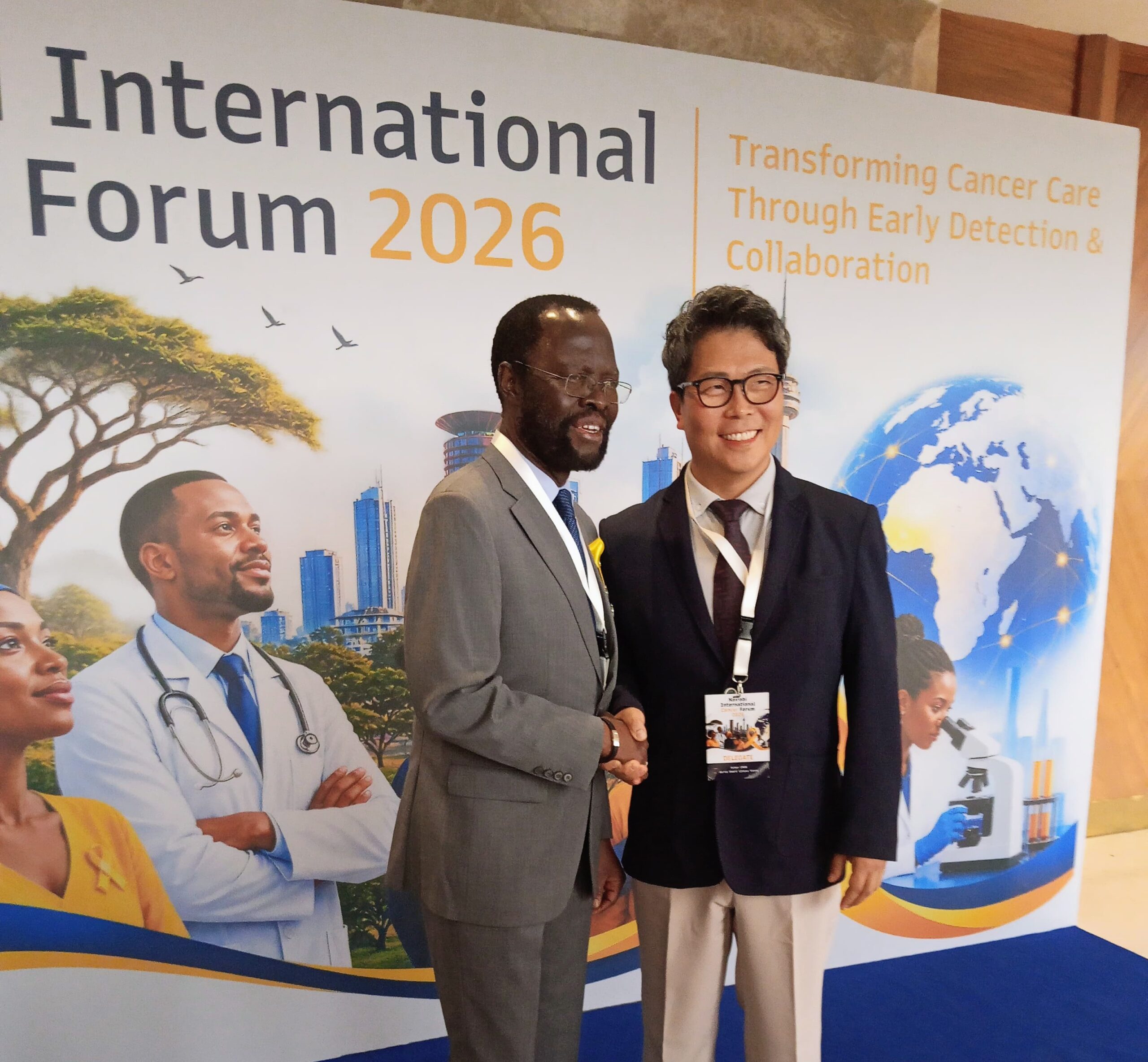
For Kisumu Governor Anyang’ Nyong’o, expanding access to diagnosis is therefore becoming a priority.Speaking about cancer care during Nairobi International Cancer Forum, Nyong’o says the county is working to build its capacity by training doctors and nurses and strengthening facilities so that patients do not have to travel long distances for care.
For years, patients in western Kenya who required specialized cancer services often faced referrals to Nairobi. Those who could not access adequate treatment locally could end up travelling abroad, at considerable cost.Nyong’o knows the consequences of delayed diagnosis personally.
He says he experienced late diagnosis himself and eventually travelled to California for treatment after seeking further medical assistance through his family.
His experience has reinforced his belief that Kenya needs stronger cancer infrastructure closer to communities. “We are trying to build capacity for diagnosis in Kisumu,” he says.
The effort is being supported by international partnerships, including a collaboration involving Jaewon Peter-Chun, chairman and CEO of the World Small Cities Forum and founder of the Africa Small Cities Intelligence Alliance.Chun’s commitment to cancer care is also deeply personal.
His sister lived with breast cancer for 13 years before her death. Her experience, he says, convinced him that cancer care must go beyond hospitals and medical procedures. Cancer patients need psychological, physical and family support, he argues.
That conviction has contributed to plans for a cancer center in Kisumu, alongside efforts to strengthen screening, train healthcare workers and bring specialized equipment into the region.
Chun says the partnership is expected to begin with early screening, training of local doctors, nurses and engineers, and mobilization of specialized equipment.A laboratory is planned at Victoria Hospital, with investment of about $1 million, to support early cancer screening programmes.
The wider ambition is to reach hundreds of thousands of people around the Lake Victoria region through screening programmes.The emphasis on early detection reflects a concern shared by Nairobi City County.
Suzanne Silantoi, Nairobi’s County Executive Committee Member for Health, Wellness and Nutrition, says the capital carries a particularly heavy responsibility because patients from across Kenya seek care in its health facilities.
According to figures she cited, 2,150 breast cancer cases were diagnosed across Nairobi facilities in 2025, while 550 cases were reported in one year in the county.
She also pointed to a national burden estimated at more than 42,000 new cancer cases and more than 27,000 cancer deaths.Behind those numbers, she says, are individuals, families and communities whose lives are changed by cancer.
Nairobi is responding by intensifying screening in health facilities and through community outreaches. The county is also working to strengthen diagnostic capacity, including access to CT scans, MRI machines and mammography.It is also moving towards expanding treatment capacity.
Silantoi says Nairobi plans to launch a cancer treatment center, an effort she describes as significant because county governments have traditionally relied heavily on national-level institutions for cancer treatment.
The goal is to bring cancer care closer to patients while strengthening partnerships with the national government, pharmaceutical companies, diagnostic companies and civil society organizations.But for Silantoi, infrastructure alone will not solve the cancer challenge.
Partnerships must strengthen local institutions, healthcare workers and systems so that progress can continue after external support ends.The ambition is simple: where a person lives or how much they can afford should not determine their chances of surviving cancer.
For Muchirwo, however, the future of cancer care must go even further.He believes innovation should not only be measured by machines, medicines or diagnostic technologies. It should also be reflected in the way health systems treat people.“Is there care being offered in our health systems as innovative as the technologies we use to treat patients?” he asks.His question goes to the heart of what he believes Kenya’s cancer response must become.A patient is more than a diagnosis.
They are a parent, child, friend, colleague or professional. They have fears, hopes, relationships and ambitions that continue even after cancer enters their lives.Muchirwo says the stigma attached to cancer can sometimes weigh more heavily on patients than the disease itself.
He wants a different model—one centered on dignity, care, love, emotional wellbeing and quality of life.For him, calling his experience a “season” rather than a battle is deliberate.
Everyone experiences different seasons in life, and cancer is one season he did not choose but has learned to navigate.After nearly 11 years, he refuses to let the disease become his entire identity.
Cancer changed his understanding of life and death, but it also taught him to appreciate the moments that remain.That lesson is increasingly relevant as Kenya seeks to transform cancer care from a system dominated by late diagnosis and expensive referrals into one built around prevention, early detection, accessible treatment and compassionate care.
The challenge is enormous, but the people at the center of the conversation are asking for more than survival.
They are asking to live with dignity.
They are asking to be heard.
And they are asking for a healthcare system that sees the person before it sees the disease.
For Muchirwo, that is what a better cancer future should look like.“A better cancer future is not just about better protection and treatment,” he says. “It is also about the human being, wholeness, dignity, care, love and joy.”