
Anti-Counterfeit Authority Launches Major Crackdown on Illicit Alcohol, Fake Fertiliser and Pirated Exam Materials in Kenya
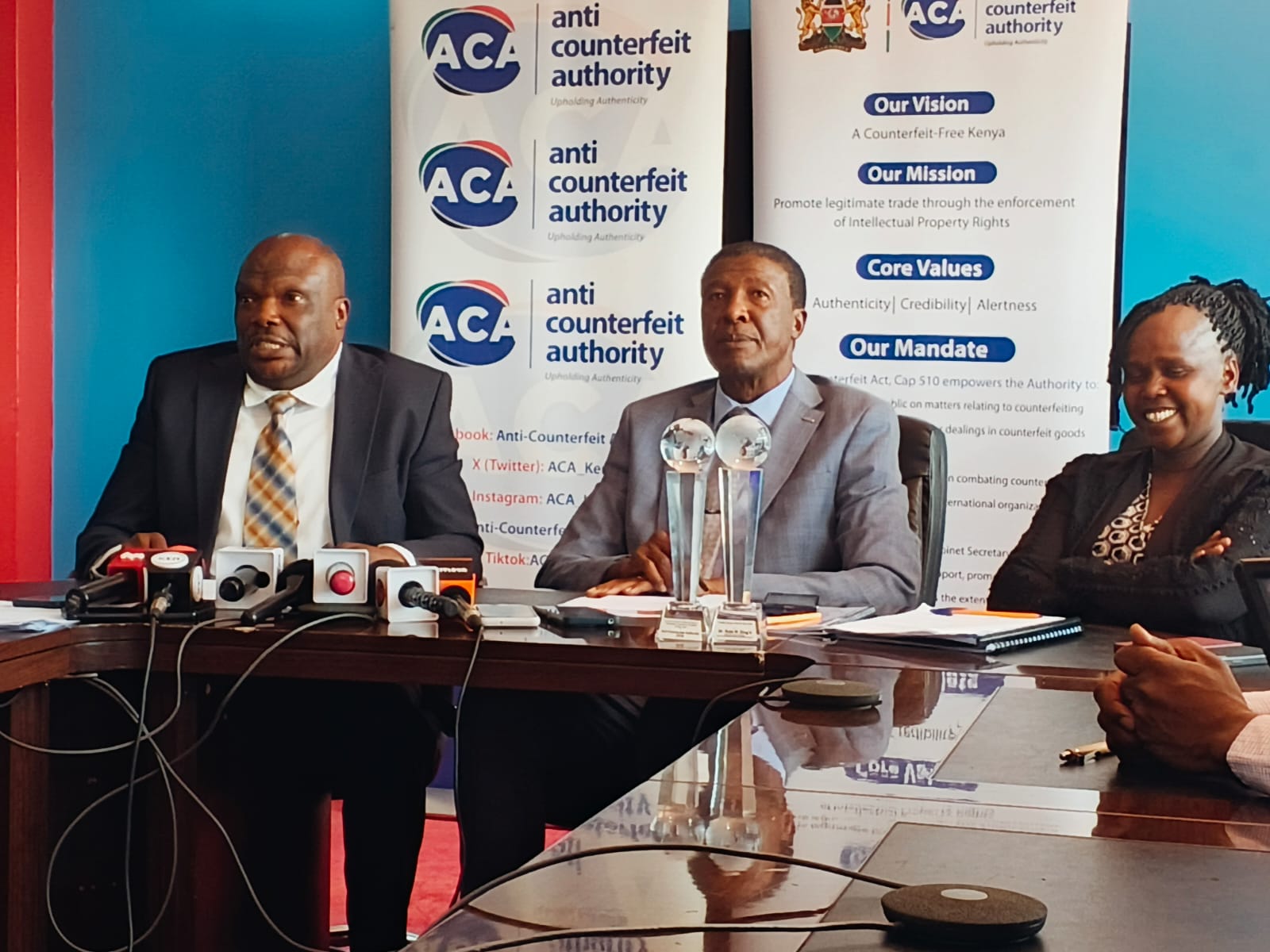
NAIROBI, Kenya, Oct 22 – The Anti-Counterfeit Authority (ACA) has announced a nationwide enforcement campaign to crack down on counterfeit goods and illicit trade, warning that the economic and human toll of fake products threatens public health, agriculture, and education across the country.
The heightened operations come as demand builds for consumer goods ahead of the upcoming festive season and the national agricultural planting period.
“Counterfeit and illicit trade imposes a cost on our country that cannot be measured in money alone,” said Nelson Ributhi, Chairperson Board of Directors, Anti-Counterfeit Authority .
“It is borne by the farmer whose harvest fails because of counterfeit inputs, by the consumer exposed to dangerous alcohol, by the student relying on substandard learning materials, and by families whose health is put at risk.”
Recent multi-agency operations highlight the alarming scale of illicit trade in Kenya.
During a Rapid Results Initiative (RRI) conducted across high-risk areas in Nairobi between August 20 and September 3, 2026, enforcement officers made 36 arrests, seizing over 5,555 suspected counterfeit bottles and approximately 39,580 litres of illicit brew.
Dagoretti North proved to be a major hotspot, accounting for roughly 27,330 litres of recovered illicit alcohol.
In Kayole, officers seized more than 5,000 bottles, while another 868 assorted alcoholic beverages were impounded in Eastleigh.
The crackdown extended beyond the capital: ● Makindu: On September 15, officers working with local police seized 8,459 suspected counterfeit alcoholic products valued at KSh 2.1 million.
● Nairobi, Nyeri, and Eldoret: Additional operations pushed the total value of goods recovered in September alone to approximately KSh 3.74 million.
The ACA also noted an aggressive push against counterfeit tobacco and nicotine products, including cigarettes carrying forged excise stamps and fake brand names, illicit e-cigarettes, vapes, refill liquids, rolling papers, and filters.
“Because these products bypass regulatory oversight, the Authority warned that their contents pose unverified health risks while depriving the government of tax revenue”.
To combat this, ACA is partnering with the Kenya Revenue Authority (KRA), the Kenya Bureau of Standards (KEBS), the Ministry of Health, and trademark rights holders to intensify inspections.
The agricultural sector has also been hit hard by counterfeiters. Last Friday, ACA officers in Matungu, Kakamega County, intercepted an operation involving illegally repackaged fertiliser. Authorities impounded two loaded lorries alongside industrial packaging equipment.
Preliminary investigations revealed that fertiliser originally intended for the Government’s subsidy programme was diverted, repackaged into counterfeit branded bags, and offered at inflated commercial prices.
The Authority condemned the scheme, noting that inputs meant to make farming affordable for ordinary Kenyans were instead being exploited for private gain.
With candidates currently sitting their national examinations, ACA has turned its focus to the education sector. Officers are actively targeting pirated textbooks, revision books, and substandard mathematical sets and calculators bearing fake brand names.
The Authority cautioned that pirated educational materials often contain critical errors, omissions, or outdated curriculum content, while non-compliant calculators and mathematical sets compromise accuracy during exams.
Highlighting the scale of the issue, ACA noted that stationery was among the highest-value categories destroyed during its most recent destruction exercise.
In response, inspectors will step up unannounced visits to bookshops, stationery wholesalers and school suppliers nationwide.
As demand for foodstuffs, personal care items, alcohol, and agricultural inputs surges over the coming weeks, the Anti-Counterfeit Authority urges Kenyans to remain vigilant and take the following precautions:
Verify Outlets: Purchase goods only from licensed, reputable retailers and authorized distributors.
Inspect Packaging: Carefully check seals, safety labels, and packaging for signs of tampering.
Validate Authenticity: Verify excise stamps and KEBS standardisation marks through official verification channels before buying.
Source Directly: Farmers are advised to acquire subsidised fertiliser strictly through government-sanctioned channels, while parents and school administrators should buy learning materials directly from authorised publishers.