Kenyan firms seek more than buyers as China-linked fashion expo opens in Nairobi
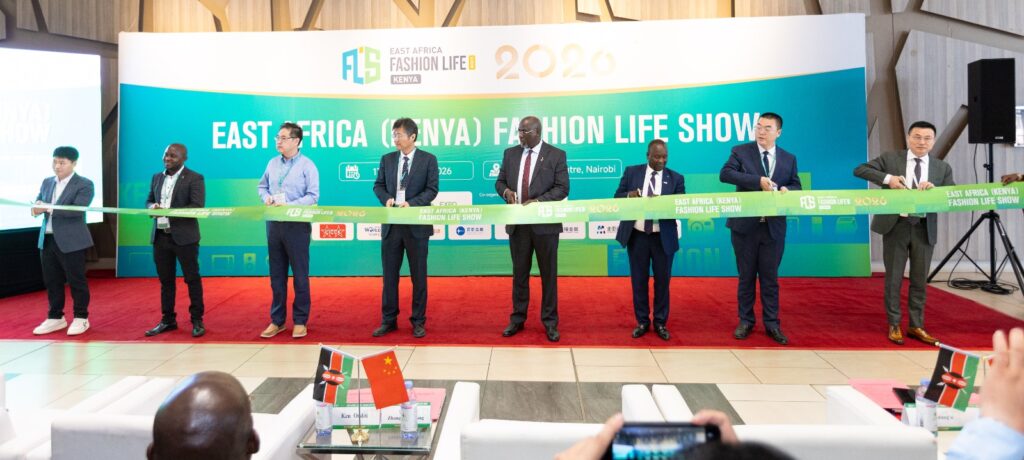
PHOTO: Delegates led by KNCCI National Director Mr Ken Onditi ,[Far Left] Afripeak Expo Kenya Managing Director Gao Wei cut ribbon during the opening of the third edition of the East Africa (Kenya) Fashion Life Show Expo at Sarit Centre,Nairobi .
NAIROBI, Kenya, Aug 14– For Kenyan businesses exhibiting at the East Africa (Kenya) Fashion Life Show, the three-day event is about more than displaying products and hoping for customers.
It is a chance to find the partnerships, technology, suppliers and markets that could determine whether a small or growing enterprise remains local or expands beyond Kenya’s borders.
Nearly 120 companies from Kenya, China and other parts of East Africa have converged at the Sarit Expo Centre in Nairobi for the third edition of the exhibition, which opened on Thursday.
The show brings together manufacturers, suppliers, distributors, investors and buyers across fashion, lifestyle and consumer goods, creating a marketplace where businesses can test ideas, negotiate partnerships and explore new routes into regional markets.
Representing the Kenya National Chamber of Commerce and Industry (KNCCI) at the opening, National Director Ken Onditi said such platforms are increasingly important as businesses face a more competitive global economy.
“Platforms that connect manufacturers, exporters, distributors, investors and buyers are no longer optional; they are essential for sustainable economic growth,” Onditi said.
For Kenyan exhibitors, the opportunity is particularly significant. Eight KNCCI member companies are participating, including Boxleo Courier & Fulfillment Services, Huru International, Jonerics Cargo Forwarders, Pharmaplus, Kiseki, Sheprenuer, Sunda International and Buruk General Trading.
Their presence reflects a broader shift in how Kenyan businesses are approaching international exhibitions,not simply as places to sell products, but as spaces to build relationships that can unlock new markets.
Onditi urged buyers and investors to visit the Kenya Pavilion and engage directly with the participating firms, saying the companies demonstrate the “diversity, resilience and entrepreneurial spirit” of Kenya’s private sector.
But the bigger question is what happens after the exhibition closes.
Afripeak Expo Kenya Managing Director Gao Wei said organisers are placing greater emphasis this year on targeted business matchmaking, with the intention of turning conversations at the exhibition into longer-term commercial relationships.
The aim, he said, is to facilitate sourcing agreements, distribution partnerships, investment opportunities and other forms of business cooperation.
That approach could be particularly important for Kenyan enterprises looking to compete in markets where access to affordable inputs, technology, logistics and reliable distribution networks can determine whether a product succeeds.
For a Kenyan fashion or consumer-goods entrepreneur, for instance, meeting an overseas manufacturer could open access not only to finished products but also to materials, equipment, product development expertise or manufacturing partnerships.
Chinese manufacturers participating in the exhibition get an opportunity to see East African consumers and businesses up close, giving them a better understanding of local preferences, pricing, distribution systems and the requirements of entering the regional market.
The organisers say the potential partnerships could extend into contract manufacturing, branding, technology transfer, logistics, warehousing, assembly and cross-border e-commerce.
This makes the exhibition less about a three-day display and more about how international businesses can build a presence in East Africa.
Kenya is particularly important to that ambition because of its position as a commercial and logistics hub in the region.
Afripeak is positioning the country as a potential base for international companies seeking to establish distribution, warehousing, assembly, manufacturing, branding, e-commerce and after-sales operations serving East African markets.
The push comes as changing consumer preferences, urbanisation and population growth continue to create demand for fashion, household goods, electronics, beauty products and other lifestyle products across the region.
For Kenyan companies, however, the benefits will depend on whether the relationships formed at the exhibition translate into tangible business.
Onditi challenged exhibitors to use the event strategically building networks, finding partners, showcasing innovations and looking beyond the domestic market.
“Build networks, forge strategic partnerships, showcase your innovations and seize every opportunity to expand your businesses beyond borders,” he said.
The China-Kenya dimension also gives the exhibition a wider economic significance.
Chinese companies make up the majority of foreign participants, providing another avenue for commercial engagement between the two countries while giving Kenyan enterprises direct access to international manufacturers and suppliers.
For local businesses, that access could mean new suppliers and technologies. For Chinese firms, it could provide a route into a rapidly expanding East African consumer market.
The challenge now is to ensure that the connections made in exhibition halls become partnerships outside them.
As the show continues, the success of the event may therefore be measured not only by the number of exhibitors or visitors, but by the business deals, distribution arrangements, investments, technology partnerships and new markets that emerge after the exhibition closes.
For Kenya’s small and medium-sized enterprises, those outcomes could matter far more than the products displayed on the exhibition stands.
KNCCI says it will continue working with partners such as Afripeak to strengthen regional value chains, promote exports and position Kenya as a trading and investment hub.
For the entrepreneurs gathered at Sarit Expo Centre, the immediate task is simpler: turn a handshake into a business relationship and a business relationship into an opportunity to grow beyond Kenya.