
ICRISAT Governing Board Commits to Sustainable Food Security in Africa
NAIROBI, Kenya, Oct 6 – The Governing Board of the International Crops Research Institute for the Semi-Arid Tropics (ICRISAT) has reaffirmed its commitment to strengthening agricultural research, higher education, and strategic partnerships to bolster food and nutrition security across Africa, with a targeted focus on the continent’s drylands.
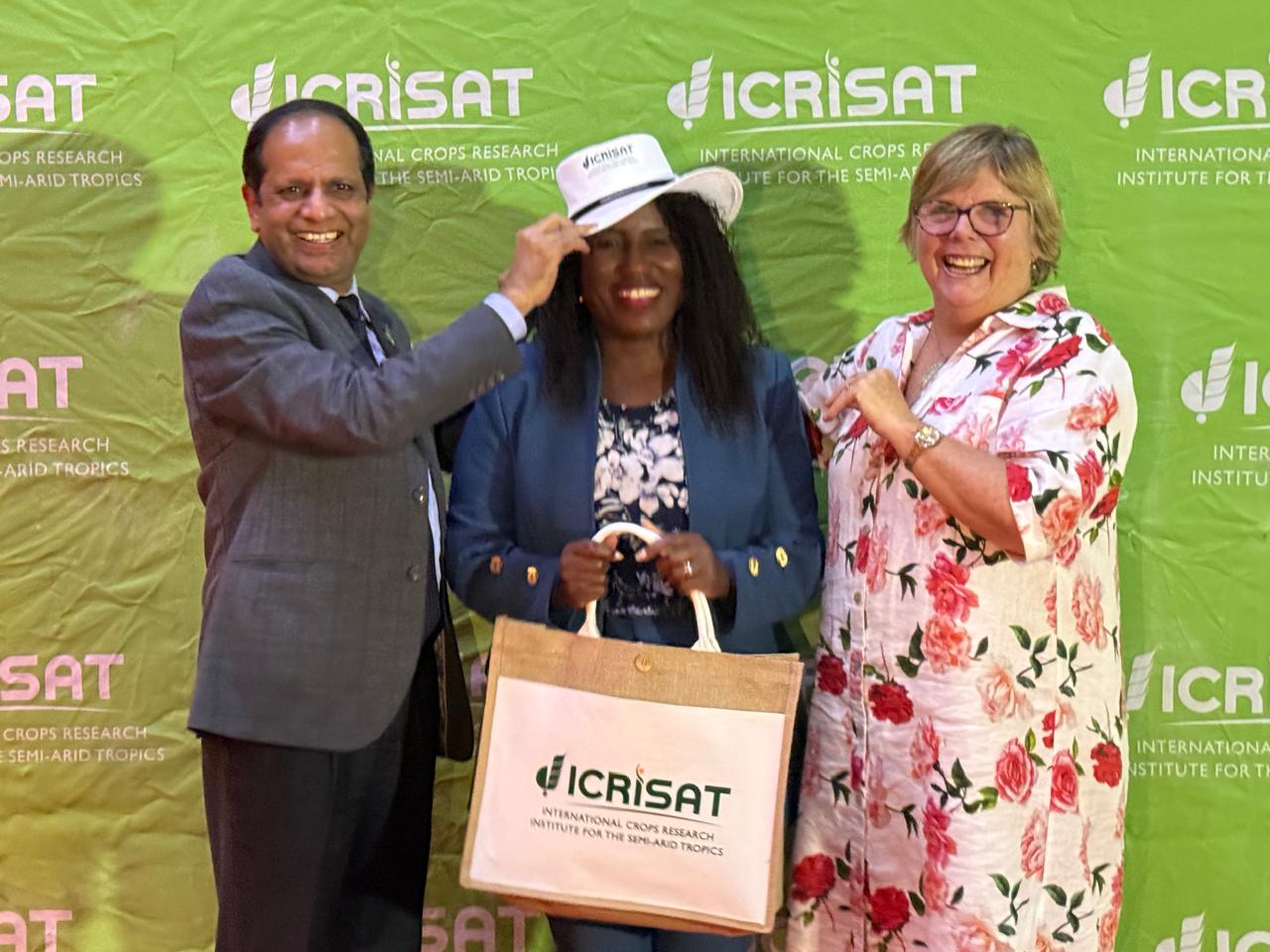
The partners dinner held at Kenyatta International Convention Centre (KICC) brought together the ICRISAT Governing Board, Government representatives, research and academic partners and other stakeholders to reflect on the role of science and partnerships in accelerating agricultural transformation.
ICRISAT Governing Board Chair Cathy Reade while speaking during the partners dinner highlighted the necessity of sustained investments in science, technology, and collaborative frameworks as Africa faces intensifying climate change, growing food insecurity, and pressure on natural resources.
Ms. Reade emphasized that addressing the vulnerabilities of semi-arid regions requires active multi-sectoral engagement.
“Our commitment is to ensure that research continues to translate into practical solutions for the communities that depend on the drylands,” said Ms. Reade.
“We need strong partnerships with academia, governments, and other partners to take knowledge, innovation, and technology further and faster.”
ICRISAT’s mandate centers on developing resilient dryland farming systems to tackle hunger, malnutrition, poverty, and environmental degradation across the semi-arid regions of Asia and Sub-Saharan Africa.
The Governing Board Chair noted that the longstanding bilateral relationship between Kenya and India serves as a strategic foundation for expanding opportunities for Kenyan universities, students, and researchers particularly those in Arid and Semi-Arid Lands (ASALs).
She observed that higher education institutions situated in dryland zones are uniquely positioned to serve as regional hubs for climate-smart agriculture, seed systems, farm mechanization, water management, and agricultural value addition.
Welcoming the initiative, Dr. Beatrice Muganda Inyangala, Kenya’s Principal Secretary for the State Department for Higher Education and Research, stressed the pivotal role of local universities in building human capital for agricultural transformation.
“About 80 percent of Kenya is arid and semi-arid For us, dryland agriculture is not agriculture at the margins; it is the agriculture of our future, We must therefore invest in the universities, researchers, and young people who will develop the solutions required for these environments”, Dr. Inyangala stated.
Dr. Inyangala advocated for expanding academic pathways including fellowships, student exchanges, and joint research ventures leveraging both the Kenya–India bilateral relationship and ICRISAT’s institutional network.
She specifically called for structured engagement with dryland-based universities, including Garissa University and Tharaka University.“These universities should not be seen simply as institutions serving remote communities,” Dr. Inyangala added.
“They can become centers of excellence for the agriculture of the future. We want to see them connected to ICRISAT and to universities and research institutions in India.”
Dr. Inyangala also pointed to ICRISAT’s ongoing partnership with Egerton University as an established benchmark for broader institutional collaboration.
Leveraging South-South Cooperation PlatformsTo accelerate academic and scientific exchange, Dr. Inyangala urged deeper integration with the Maharishi initiative and ICRISAT’s Center of Excellence for South-South Cooperation in Agriculture (ISSCA).
ISSCA acts as a global platform for sharing scalable agricultural innovations across the Global South, focusing on: Crop improvement and resilient seed systems Agribusiness development and value addition
Digital agriculture and precision farmingClimate resilience and livestock managementIn 2026, ICRISAT utilized ISSCA alongside India’s Technical and Economic Cooperation (ITEC) program to conduct international training programs in digital and regenerative agriculture, drawing participants from 25 countries.
Dr. Inyangala urged ICRISAT to expand Kenya’s access to these specialized capacity-building pipelines to forge direct linkages between higher education, scientific research, agritech enterprise, and smallholder farmers.
Moving Scientific Innovation to Field ImpactICRISAT Director General Dr. Himanshu Pathak reaffirmed that the institute’s primary objective remains the translation of laboratory research into field-level outcomes.
“No single institution can solve the food, climate, and livelihood challenges facing the drylands,” Dr. Pathak stated. “We need partnerships that bring together science, policy, education, industry, and farmers.”
Dr. Pathak who previously served as Secretary of India’s Department of Agricultural Research and Education (DARE) and Director General of the Indian Council of Agricultural Research (ICAR) stressed that cross-border collaboration is critical to scaling agricultural resilience.
“Our objective is to move from knowledge to action from research to innovation, from innovation to adoption, and ultimately from adoption to impact for farmers,” Dr. Pathak explained.
“India has an enormous body of experience in agricultural transformation. Kenya has its own knowledge, institutions, and innovations. The opportunity is to bring these strengths together and co-create solutions that are relevant to African conditions.”
Closing the engagement, Dr. Inyangala emphasized the importance of viewing semi-arid regions through the lens of economic potential rather than environmental limitation. She called for targeted capital investments in key agricultural sectors.