Kenya Unveils Sh26bn Plan to Rescue Degraded Landscapes in 12 Counties
By Fride Amiani
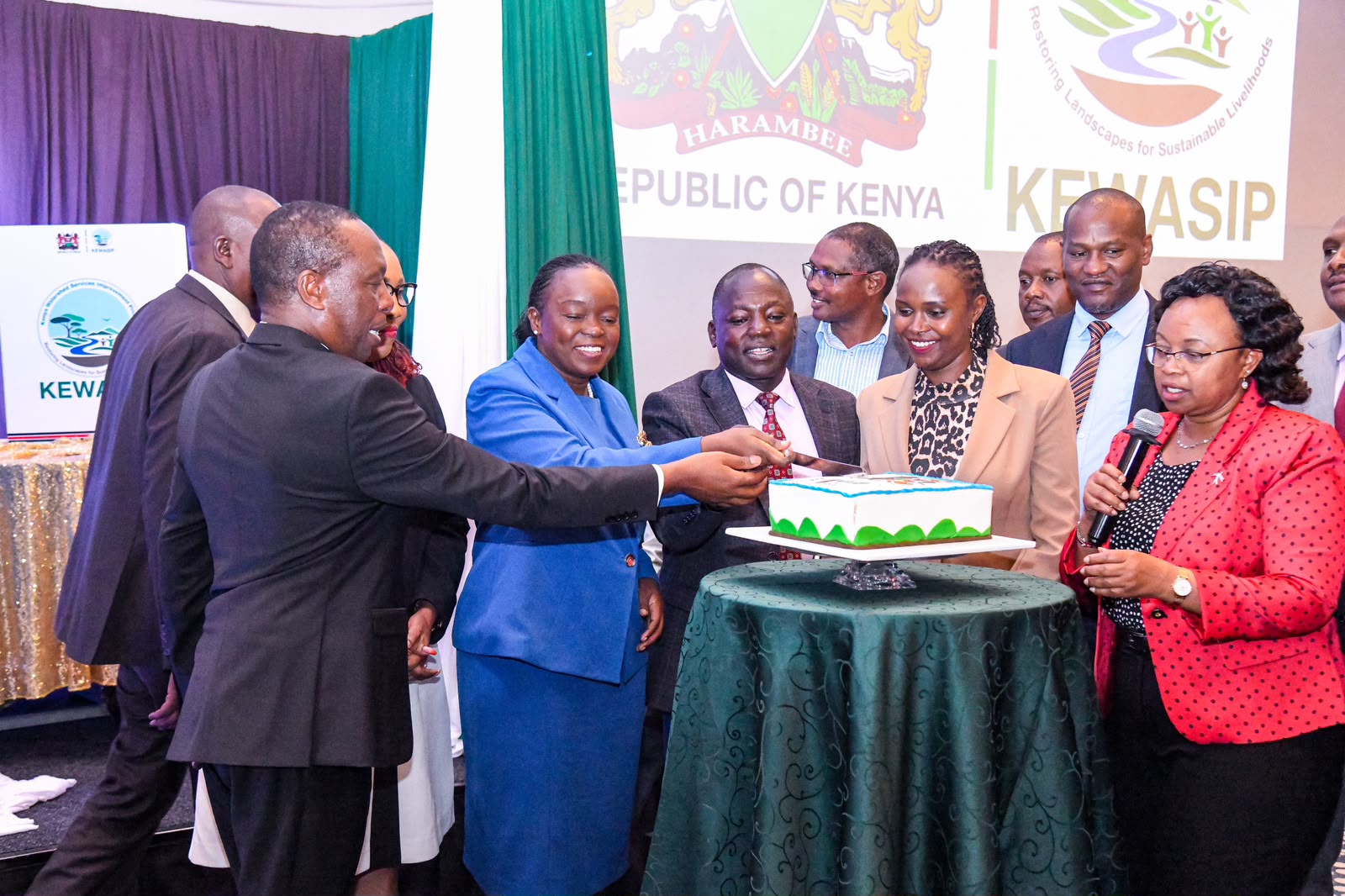
PHOTO: Environment, Climate Change and Forestry CS Dr Deborah Barasa and Principal Secretary Gitonga Mugambi cut a celebratory cake during the launch of the Sh26 billion Kenya Watershed Services Improvement Project (KEWASIP) in Nairobi on November 2, 2026.
NAIROBI, Kenya, Nov 2 – The Government has launched a Sh26 billion environmental restoration programme targeting 12 counties in a major initiative aimed at rehabilitating degraded landscapes, improving water security and strengthening communities’ resilience to climate change.
The five-year Kenya Watershed Services Improvement Project (KEWASIP), financed through a US$200 million (approximately Sh26 billion) World Bank investment, will focus on restoring five critical landscapes across the country while promoting sustainable management of natural resources.
The project was officially launched on Monday, November 2, 2026, at a hotel in Nairobi, by Environment, Climate Change and Forestry Cabinet Secretary Dr Deborah Barasa, who said the initiative would play a critical role in reversing environmental degradation and protecting ecosystems that support the country’s economy.
Speaking during the launch, Barasa observed that environmental destruction had increasingly become a threat to economic development, food production and the livelihoods of millions of Kenyans.
She noted that declining watershed productivity, soil erosion, reduced water availability and unsustainable land-use practices were undermining the country’s ability to sustainably manage its natural resources.”Environmental degradation is therefore not merely a conservation concern; it is an economic and development challenge,” Barasa said.
She explained that healthy watersheds were essential to sustaining agricultural production, energy generation, biodiversity and access to clean water, warning that continued degradation would expose communities to greater environmental and economic risks.
According to the Cabinet Secretary, KEWASIP would provide an opportunity to address these challenges through coordinated interventions that combine ecosystem restoration, institutional strengthening and community participation.
The project will cover the Marsabit Hills, Marmanet Hills, Nyambene Hills, Chyulu Hills and Shimba Hills, benefiting communities in Baringo, Meru, Kitui, Tharaka Nithi, Samburu, Isiolo, Marsabit, Makueni, Garissa, Kwale, Tana River and Laikipia counties.
Barasa said the programme would adopt an integrated watershed management approach, recognising that activities taking place in upper catchment areas directly affect rivers, agricultural lands and communities downstream.
She emphasised that protecting forests and water towers must go hand in hand with improving land management practices and ensuring that communities benefit economically from conservation initiatives.
The Cabinet Secretary called on the 12 county governments to demonstrate commitment to the programme by incorporating its activities into their development plans and ensuring that local communities actively participate in implementation.
She said environmental conservation could not succeed through isolated government interventions, particularly because ecosystems and water catchments extend beyond administrative boundaries.
“Environmental challenges do not respect county boundaries. This makes collaboration between the National Government, county governments and communities particularly important in ensuring sustainable management of our watersheds,” she said.
Barasa welcomed the signing of intergovernmental participation agreements and the establishment of County Project Coordination Units, describing them as important foundations for effective implementation.
She urged county administrations to translate the agreements into practical interventions, including protecting hilltops, riparian reserves and environmentally sensitive areas.
The counties were also encouraged to strengthen the management of community and county forests while promoting agroforestry and urban forestry as part of wider landscape restoration efforts.
The Cabinet Secretary further disclosed that the Ministry had completed the Adopt-a-Forest Guidelines, which are expected to encourage private sector organisations, institutions and communities to contribute resources towards forest conservation.
She said the framework would help expand partnerships beyond government financing and create opportunities for more stakeholders to participate in protecting the country’s forest resources.
The KEWASIP initiative complements the Government’s broader environmental restoration agenda, particularly the 15 Billion Tree Growing Programme, which seeks to increase national tree cover to 30 per cent by 2032.
It is also aligned with the National Landscape and Ecosystem Restoration Strategy 2025–2032, which provides a roadmap for rehabilitating 10.6 million hectares of degraded landscapes across the country.
However, Barasa cautioned against evaluating restoration efforts purely through the number of trees planted, insisting that the sustainability of such initiatives must be measured through their actual environmental and economic impact.
She said planting trees without addressing the factors responsible for environmental destruction would undermine long-term conservation objectives.
“What matters is not simply the number of trees we plant, but whether those trees survive, whether our watersheds recover, whether biodiversity is protected and whether communities experience meaningful improvements in their livelihoods,” she noted.
She added that the Government would prioritise interventions that improve seedling survival, restore watershed functions, strengthen ecosystem health and create sustainable economic opportunities for households.
KEWASIP became effective on December 23, 2025, and Barasa said important groundwork had already been undertaken to prepare for its implementation.
She called on the State Department for Forestry, implementing agencies and county governments to accelerate planned activities, strengthen coordination and ensure that the five-year programme delivers its intended outcomes.
The Cabinet Secretary also underscored the importance of involving local communities in identifying restoration priorities, carrying out conservation activities and protecting the gains achieved.
She said women, young people and vulnerable groups should be deliberately included in the programme to ensure they benefit from emerging opportunities in environmental conservation and sustainable livelihoods.
According to Barasa, communities should not be treated merely as recipients of government interventions but as key partners whose participation would determine the programme’s long-term success.
She further challenged implementing institutions to uphold transparency, accountability and prudent management of the Sh26 billion investment, warning that the resources must translate into tangible benefits.
The project brings together several government institutions, including the Kenya Forest Service (KFS), Kenya Forestry Research Institute (KEFRI), National Environment Management Authority (NEMA), National Environment Trust Fund, Water Resources Authority and Kenya Wildlife Service.
The State Department for Wildlife and the State Department for Irrigation are also part of the implementation framework.Barasa urged the participating institutions to work collaboratively and avoid fragmented approaches, noting that successful watershed management requires expertise and coordinated action across different sectors.
She acknowledged the World Bank’s financial and technical support, saying the partnership would strengthen Kenya’s capacity to address environmental challenges and promote sustainable natural resource management.
The Cabinet Secretary maintained that the benefits of restoring degraded landscapes would extend beyond environmental protection to include improved food security, reliable water supplies, energy production and stronger local economies.
“KEWASIP presents an opportunity to demonstrate that environmental conservation, economic development and improved community livelihoods can be achieved together,” she said.
She challenged all participating institutions, development partners and county governments to approach implementation with urgency and shared responsibility.
Barasa said the ultimate measure of success would be the programme’s ability to deliver healthier watersheds, restored ecosystems, improved livelihoods and communities better equipped to withstand climate-related challenges.
The launch marks a significant step in Kenya’s efforts to link environmental conservation with sustainable economic development, with the success of the initiative expected to depend on effective coordination, community ownership and accountability in the utilisation of resources.