Stop Counting What You Plant, Start Counting What Survives: Dr. Isaac Kalua Green Challenges Global Conservation Strategy
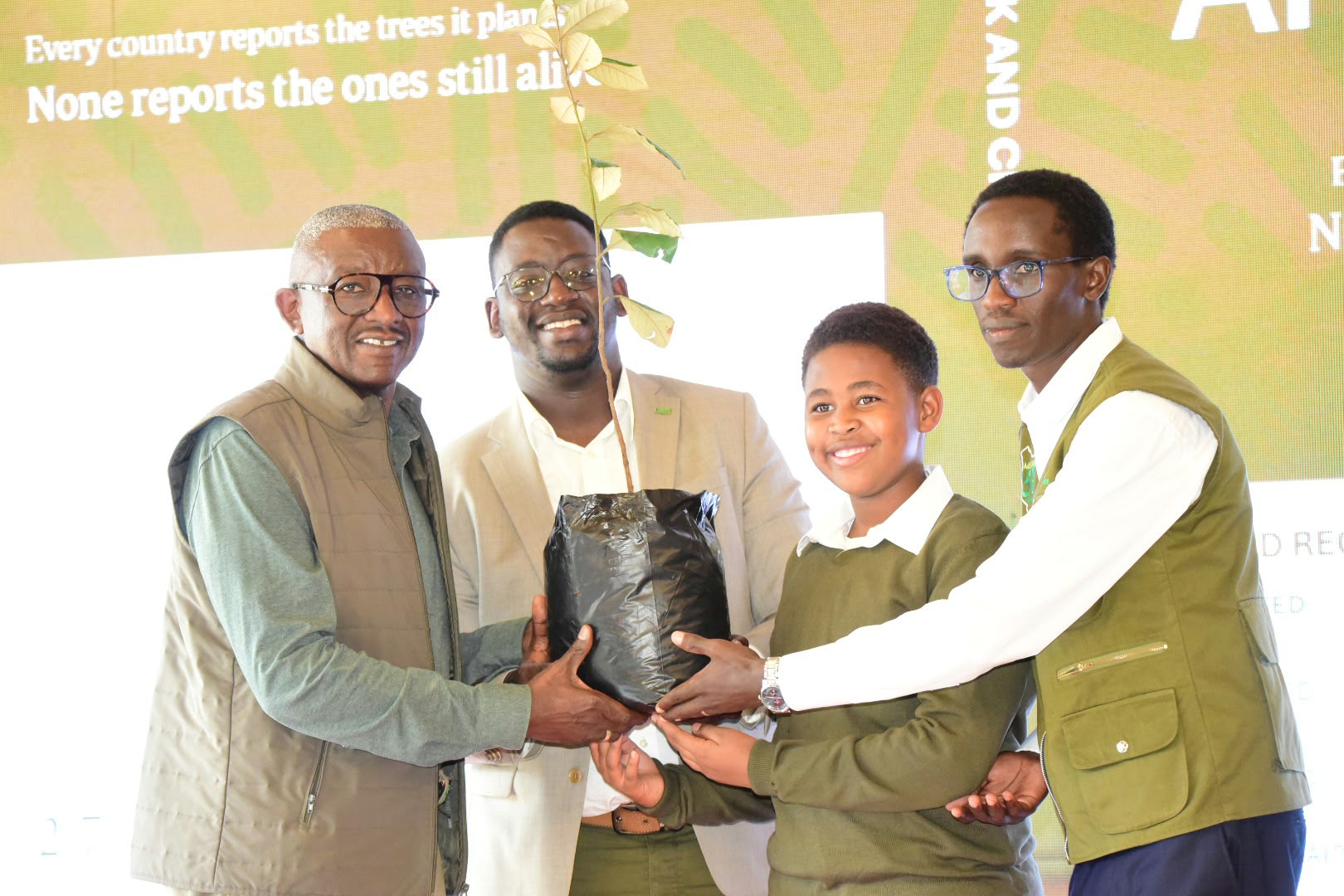
NAIROBI, Kenya, Sept 14 – In an impassioned address calling for a fundamental shift in global environmental strategy, prominent Kenyan environmentalist Dr. Isaac Kalua Green has issued a radical challenge to the conservation movement: stop counting the number of saplings planted, and start tracking how many actually survive.
Speaking at the launch of his new book, Come Back and Check, marking his 57th birthday and 50 years of planting trees in a different way and handing over the Plant Your Age movement to the next generation, Dr. Kalua highlighted the vast, unmonitored gap between high-profile planting announcements and long-term ecological survival a space he characterized as “the largest unaudited area on Earth”.
Dr. Kalua, who has cultivated trees for half a century, served in Kenya’s public environmental institutions, and built green enterprises, begins his reckoning by turning the spotlight onto himself.
“Today, we are in this room, not planting a tree,” Dr. Green stated. “We have to recalibrate ourselves to start afresh. We lose ourselves when we get to the ground where we are planting trees completely.
“From “Why” to “So What?”: The Paradigm ShiftReflecting on years of environmental advocacy, Dr. Green outlined the evolution of the conservation debate through three central questions: “What,” “So What,” and “And Then What.”
While the “What” focuses on recognizing the indispensable value of trees as food, medicine, income, and climate resilience, the primary breakdown occurs at the “So What” phase: maintaining post-planting accountability.”We are excellent in reporting the number of trees that we are planting or have planted, but there is no accountability,” Dr. Green noted.
“No one owns the tree. One year over, nobody is reporting the number of trees that are surviving”.
Dr. Green highlighted historical precedents, referencing how the late Nobel Laureate Professor Wangari Maathai’s initial call to plant 71 trees mobilized Kenyans to plant 15.7 million trees within a single year, driven by genuine ownership rather than high-cost national campaigns.
Addressing national initiatives, including the presidential campaign to plant 15 billion trees, Dr. Green argued that reliance on massive public budgets misses the fundamental point of sustainable enterprise.
“The discussion unfortunately went to the fact that we need 16 billion Kenyan shillings to grow 15 billion trees,” Dr. Green said.
“How can the nation prosper that way when an example was shown: just plant your age, keep going with the little that you can.”
A key focus of the address was the economic distortion caused by government distribution of free tree seedlings. Dr. Green argued that providing free seedlings undermines local youth entrepreneurs trying to build commercial nurseries and discourages public responsibility.
“Why should I give you a mango tree for free when it is you who is going to benefit out of it?” Dr. Green asked. “We are discouraging young people who are doing tree production and would want to earn a living. You pay for products in the supermarket. We must change that mentality in Kenya so that what you do, you have earned.”
To demonstrate actionable accountability, Dr. Green highlighted a new record documenting 981 million trees, mapped using a verification framework containing seven key criteria.
The Plant Your Age Movement: The campaign reports a central estimate of approximately 981 million tree-growing contributions between 2011 and June 30, 2026 (placed within a broader range of 700 million to 1.2 billion).
Kalua explicitly separates this contribution metric from an independently verified count of living trees. The “Seven Questions” Audit: Putting his own movement through a strict seven-point evaluation, Kalua openly acknowledges that the initiative could only fully or partially answer two questions, inviting external institutions to independently audit his records.
Commercial Realities: Reflecting on his early success in running a tree-nursery business which famously earned him enough to buy a dream childhood Mercedes-Benz he points out that while invoices proved how many saplings were sold, they offered no proof of how many survived once they left his hands.
Drawing on ecological recovery models including South Korea’s historical forest rehabilitation, farmer-managed natural regeneration in Niger, and public audit frameworks in the Philippines, Come Back and Check argues that trees only survive when local communities possess both the incentive and the financial means to nurture them.
To bridge the accountability gap, Dr. Kalua introduced practical toolkits designed for both public and private institutions: The Seven Questions: A framework to scrutinize and verify any public tree-planting claim.
Count What Survives Standard: A metric focused strictly on established, living vegetation rather than initial sapling counts.
The Evidence Ladder: A tiered verification system ranking data confidence, requiring dated documentation.
Living Tree Account: A ledger where sapling losses are recorded and replacements tracked separately.
The Stake Gradient: A model exploring how an individual’s direct stake in a tree’s future shapes the level of care it receives.
World record holder and 15 Billion Trees Ambassador Hillary Kibiwott has urged Kenyans to shift their mindset from simply planting trees to actively growing them to ensure long-term environmental restoration.
Speaking at the launch of the Plant Your Age movement under the theme “My Age, My Trees, My Legs,” Kibiwott emphasized that national climate goals require personal accountability and year-round stewardship rather than symbolic, one-off events.”The message behind Plant Your Age is simple, but its potential is enormous,” said Kibiwott.
“It encourages every person to transform a personal milestone whether it is a birthday, anniversary, or graduation into a living environmental legacy. If you are 20 years old, grow 20 trees. When millions make that commitment, individual action becomes a powerful national movement.”
Kibiwott, who holds the individual world record for planting 33,306 trees non-stop in a 24-hour period, noted that his personal conservation efforts have mobilized communities to plant over 3.3 million seedlings since 2017, maintaining a survival rate of over 90 percent.
Addressing the national goal set by President Ruto to grow 15 billion trees by Vision 2030, Kibiwott insisted that success hinges on community engagement and proper follow-through.
”We must move from tree-planting to tree-growing from focusing on numbers to tracking survival,” he stated. “
“The real measure of our success is not how many seedlings we put into the ground, but how many survive, grow, and benefit our ecosystems. We must ask ourselves: How many survived? Who is taking care of them? Where are they located?”
He urged citizens not to view the 15 Billion Trees campaign merely as a government agenda, but as a collective civic duty involving households, schools, faith-based organizations, and private institutions.
“Let us change the conversation from ‘What is the government doing?’ to ‘What am I doing to help Kenya grow its 15 billion trees?'” Kibiwott urged. “Fifteen billion trees are doable if every Kenyan owns the responsibility”.
With the upcoming Mazingira Day celebrations approaching, the ambassador called on households and institutions to prepare early by identifying planting sites and securing seedlings ahead of the seasonal rains.
“We should not wait until Mazingira Day or until the rains arrive to start searching for seedlings,” he added. “Let us make environmental conservation a permanent part of our national culture.”
While anchored in forestry, the core message extends far beyond environmental restoration. Through what he terms The Law of the Second Visit, Dr. Kalua applies the discipline of returning and verifying to governance, business, education, and personal relationships.
Rooted in his family upbringing his mother’s insistence on seeing tasks through and his father’s patient care for young seedlings the book transforms the act of tree growing into an ongoing personal commitment.
Through the Plant Your Age movement, a birthday becomes an annual appointment with a living legacy: planting for the years lived, securing their long-term care, recording outcomes transparently, and passing the stewardship forward.
The initiative aims to connect individual efforts directly to transparent data without relying solely on top-down state financing or immediate carbon-credit speculation.
”I can take you where they are. I can refer you to who is there,” Dr. Green affirmed, adding that a copy of the documentation was presented for international tracking regarding maritime and ocean conservation impacts.
Concluding the address, Dr. Green urged citizens, non-governmental actors, and private partners including representatives from Green Africa and environmental ambassadors to view environmental action through personal responsibility rather than financial incentives alone.
”The 15 billion trees will not be planted by the government. There is no money like that, and there will never be money enough to do that. Those trees will be planted by us.”